
Planning For “Rushtok”: Legal Considerations and Brand Impact
The growth of “RushTok” — the name often given to TikTok, Instagram, and other social media content tied to sorority recruitment, or rush — has continued to accelerate every year. Elaborate choreographed chapter videos and video journals from prospective members have become a de rigueur part of the recruitment process.
That now-annual ritual has created its own social content economy, including sorority members and hopefuls becoming influencers, brands looking for a boost through association with those individuals or entire sorority houses, and agencies hoping to orchestrate the next viral success. What started with a few rush participants gaining notoriety and tagging brands in their wardrobes now includes large-scale on-campus sampling and gifting campaigns, as well as brand-themed videos.
Brands from startups to household names have joined over the past few years. Altar’d State, Bubble Skincare, Dunkin’, Edikted, FLRT, Khloud, Tarte Cosmetics, and Nike are among the companies that have participated. Poppi prebiotic soda has long been part of the trend Instagram, reportedly distributing more than 400,000 cans to 2,500 Greek chapters last year. Nike rolled a truck up to the Alabama Gamma Phi Beta house to distribute custom embroidered hoodies Instagram . General Mills also drew attention this year when the Kappa Delta house at the University of Arkansas, whose rush theme was “Lucky me, I’m a KD,” was decked out in bright marshmallow-inspired imagery Instagram.
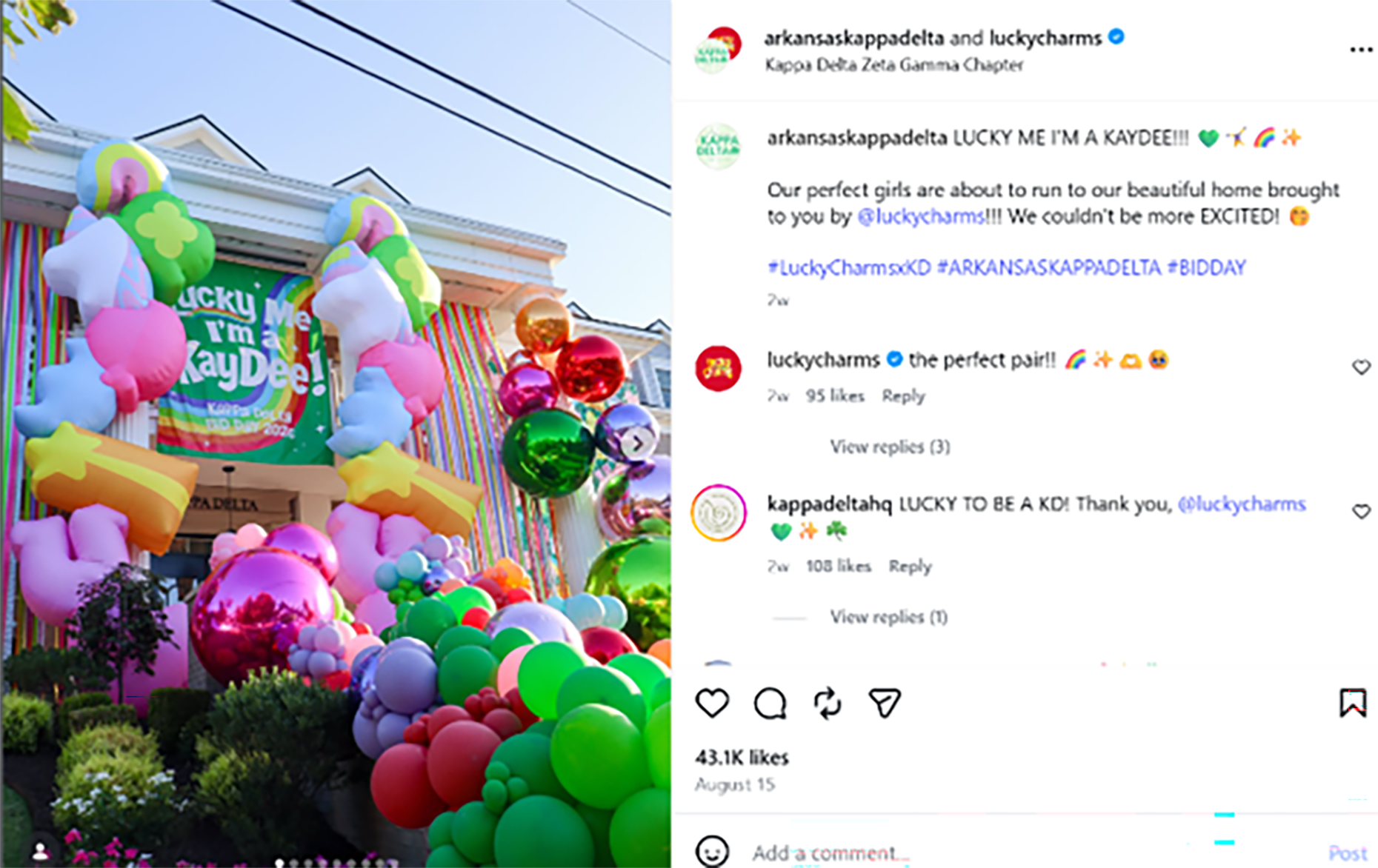
These activations range from truly organic content, to impromptu gifting, to plans developed a year in advance by sophisticated brands and chapter houses with designated “brand coordinators.” In any form, the dynamics of RushTok brand activations raise a number of legal issues that warrant careful attention after that first creative spark.
Disclosure Obligations Remain Front and Center
One obvious issue is disclosure. The Federal Trade Commission has made clear in its Endorsement Guides that influencers and brands are jointly responsible for ensuring that any “material connection” between a brand and an influencer is clearly disclosed. Gifted products can qualify as a material connection.
The FTC is also particular about how those relationships are disclosed. It recommends disclosures that are hard to miss and, in video content, ideally made in the video itself, not buried in comments or left only to a caption. In some cases, an over-the-top activation such as a Nike truck at a sorority house or a Lucky Charms-themed house makeover may itself put viewers on notice that a brand relationship exists. Some posts may also communicate that context clearly through the content itself. But a quick hashtag or an ambiguous pinned “thank you” may not always be enough.
Another disclosure area that calls for attention is affiliate content and shoppable links. Get-ready-with-me videos or rush outfit breakdowns in which the poster earns a commission on clicks or sales also require clear disclosure. The FTC has indicated that disclosures buried in a profile, generic references to an “affiliate link,” or certain platform tools may not be sufficient. By contrast, “paid link” immediately next to the link is much more likely to satisfy the standard.
AI-Generated Content Creates a Newer Disclosure Requirement
A newer disclosure question involves AI-generated content. This year, one of the hottest RushTok personalities was a potential new member known as “Janie B.” Like other hopefuls, Janie had a video detailing her rush outfit of the day. As it turned out, Janie B, and some of the branded clothing featured in the content, were fictitious AI-generated creations.
Reportedly, the account was created as an experiment rather than an advertisement. Had it been an ad, however, it could have triggered New York General Business Law § 396-B, which applies to advertisements and promotional materials and requires conspicuous disclosure of synthetic performers in such content. Other states are considering enacting similar laws. Brands considering skipping the “hassle” of humans and moving to an AI star for their RushTok content will need to manage these new laws as well as platform AI-disclosure compliance.
Entertaining content can still include claims that must be managed
RushTok posts are mostly entertainment and hype. But if the content includes express or implied product claims, branded sponsors can be liable for statements made by their sorority ambassadors.
Keeping the energy high is fine. But if a spokesperson says a gifted energy drink contains “more energy-boosting vitamins than any other soda,” that claim needs to be truthful and substantiated. RushTok content and content creators should also receive the same brand safety due diligence as any other brand content.
Intellectual Property Issues Can Create Latent Risk
Intellectual property is always a major concern in content creation, and RushTok videos can be especially precarious for the unwary. These videos often feature popular songs or lip-synced dialogue from film or television. Tracks labeled as “original sounds” are often anything but.
Although platforms may include certain copyright licenses for personal use of music, those licenses rarely extend to commercial uses of popular songs. Typically, a commercial entity producing video content with a song needs licenses for both the sound recording and the underlying musical composition, and for hits, that is rarely inexpensive. Even if content is created by a sorority member and falls within a platform license for personal use, a brand that reposts or syndicates that content may fall outside the scope of that license and expose itself to potential liability.
Brands working with a sorority chapter need to be confident they have the right permissions if consumers are likely to believe the brand is approved by, affiliated with, or otherwise connected to the trademark owner. In many cases, the relevant trademark owner may be the fraternity or sorority’s national organization, not the local chapter putting together the promotion. The national body may also have rules governing chapter and member participation in commercial activities.
Individuals also control their publicity rights, meaning the right to use their name, image, or likeness for commercial purposes. Obtaining releases from students may seem straightforward, especially when the individual just received a popular brand gift. But some members of this very young demographic may still be minors and may have the right to void a contract. Many of these productions have a very short shelf life, but advertisers should be prepared for the possibility that consent could later be withdrawn. And don’t forget the publicity rights for individuals not appearing in the content.
Takeaway
At the end of the day, RushTok videos are a public relations play for everyone involved. But an unexpected legal issue can disrupt a high-ROI campaign, create reputational problems, or at a minimum dull your sparkle. Brands, agencies, and chapters that want to capitalize on the moment should make sure legal review keeps pace with the creative.

